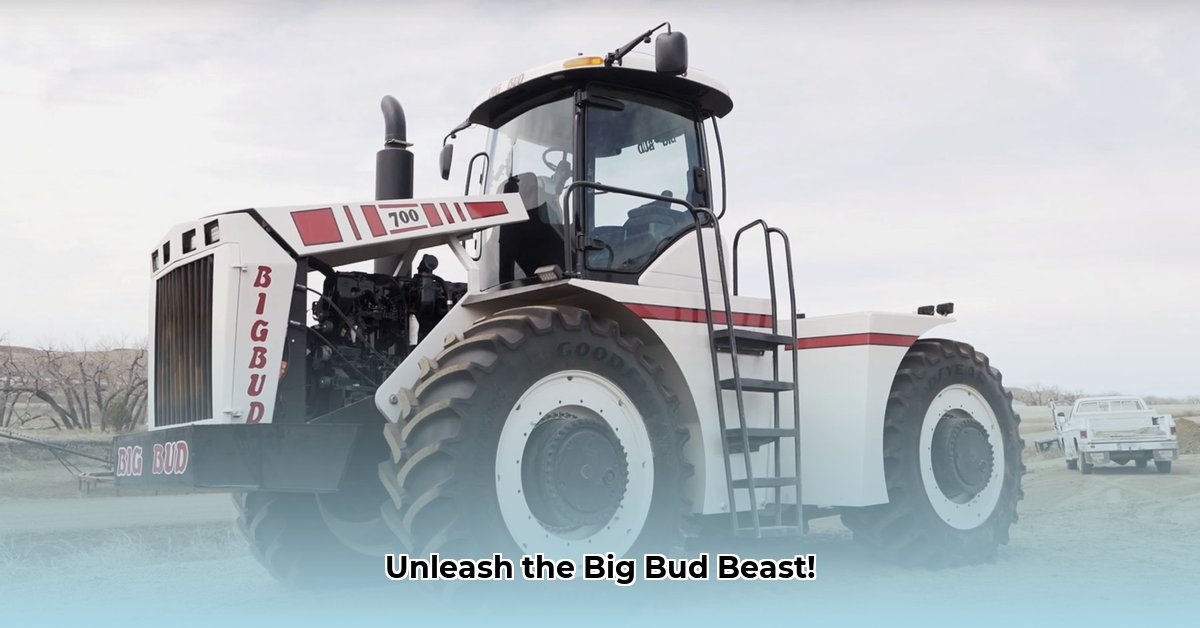
The Big Bud 700, the latest model for 2023, signifies a paradigm shift in agricultural machinery. This isn't merely about raw power—though its 640 horsepower Caterpillar engine certainly delivers—but about a revolutionary approach to ownership, emphasizing repairability and long-term cost savings. The focus on straightforward maintenance and readily available parts empowers farmers and contractors, challenging traditional repair models and offering significant financial advantages. For more production details, see the Big Bud production numbers.
A Giant Reborn: Power, Durability, and Owner Control
With its 640 horsepower Caterpillar engine, coupled with Caterpillar-sourced transmission and axles, the Big Bud 700 promises unparalleled reliability. But its true innovation lies in its commitment to straightforward serviceability. Components are designed for easy access, minimizing downtime and repair expenses. The robust 1.5-inch thick steel frame further enhances durability, suggesting an exceptionally long operational lifespan, translating to substantial long-term cost savings. Isn't this the kind of investment farmers have been longing for?
Under the Hood: More Than Just Horsepower
The heart of the Big Bud 700 is its powerful Caterpillar engine, supported by readily available parts. The modular design—a key feature—facilitates part replacement with the ease of changing a lightbulb. This ease of access is a significant advantage over many competitors. Detailed diagrams showcasing the accessibility of components would further elucidate the design's practicality.
Detailed Specifications: A Closer Look at the Big Bud 700
| Feature | Specification | Notes |
|---|---|---|
| Engine | 640 HP Caterpillar | Proven reliability and readily available parts. |
| Transmission | Heavy-duty, Caterpillar-sourced | Designed for longevity and smooth operation under heavy loads. |
| Frame | 1.5-inch thick steel | Exceptional strength and durability for extended lifespan. |
| Axles | High-capacity, Caterpillar-sourced | Built to handle extreme stress and weight. |
| Serviceability | Designed for easy component access | Significantly reduces repair time and costs, empowering owner maintenance. |
| Market Positioning | High-end, focused on longevity and control | Targets farmers and contractors prioritizing long-term value over immediate cost. |
Market Outlook: Strategic Investment or Calculated Risk?
The Big Bud 700 targets farmers and contractors prioritizing long-term value. While the initial purchase price is undoubtedly high, the long-term picture is compelling. Reduced downtime, lower repair costs, and the ability to perform basic maintenance independently offer significant cost savings. However, challenges remain. Can Big Bud meet projected demand? Will the higher upfront cost deter customers focused on immediate affordability? Market success hinges on whether the long-term savings convincingly outweigh the initial investment.
Impact Beyond Farming: Construction and Beyond
The Big Bud 700's capabilities extend beyond agriculture. Its power, robustness, and easy maintenance make it attractive to construction companies seeking reliable, long-lasting equipment. This dual-market approach diversifies the customer base, reducing reliance on the agricultural sector alone.
The Right to Repair: Empowering Owners
The Big Bud 700 implicitly supports the “right to repair” movement by prioritizing owner serviceability. This challenges the traditional model of manufacturer-controlled repairs, empowering owners and reducing dependence on expensive dealership services. This shift in power dynamics is a key advantage.
Long-Term Prospects: A Sustainable and Owner-Centric Future
The Big Bud 700's long-term success depends on various factors. Efficient production scaling is crucial to meet demand. The price point must remain competitive given the promised benefits. Furthermore, convincing customers to prioritize long-term cost savings over immediate affordability is essential. Will this model resonate with the industry's long-term needs? The Big Bud 700 potentially represents a move towards a more sustainable, owner-centric approach to agricultural and construction equipment.
How to Calculate Total Cost of Ownership for Big Bud 700 Tractor
The total cost of ownership (TCO) for the Big Bud 700 extends significantly beyond its sticker price. A comprehensive analysis is essential for a realistic assessment.
Understanding the Big Bud 700's Unique Value
The Big Bud 700’s emphasis on repairability is key to its long-term cost-effectiveness. However, quantifying these savings requires a methodical approach to calculate the total cost of ownership (TCO).
Essential Cost Components: A Holistic View
Calculating the TCO encompasses several critical factors:
- Initial Purchase Price: The starting point—the upfront cost of the tractor.
- Depreciation: The annual reduction in value.
- Taxes and Insurance: Annual costs influencing the overall expense.
- Housing/Storage: Necessary costs for maintaining the tractor's value and longevity.
- Fuel Costs: A significant operational expense, particularly for a high-horsepower machine.
- Maintenance and Repairs: Where the Big Bud 700’s design shines; its serviceability substantially reduces these costs.
- Interest Costs (If Financed): Include the cost of financing if applicable.
Calculating Your Big Bud 700's TCO: A Step-by-Step Guide
- Data Collection: Gather data for all cost components. Use estimates when necessary, based on your anticipated usage.
- Annual Costs: Sum all annual costs (fuel, maintenance, taxes, insurance, housing).
- Depreciation Calculation: Use a suitable depreciation method (straight-line or more sophisticated approaches).
- Total Annual Cost: Add the annual costs and annual depreciation.
- Long-term Projection: Multiply the total annual cost by the number of years of ownership.
- Total Cost of Ownership: Add the initial purchase price to the projected total annual cost.
Big Bud 700: Weighing the Pros and Cons
| Pros | Cons |
|---|---|
| High horsepower and large capacity | High Initial Purchase Price |
| Serviceability and repairability | Fuel Consumption |
| Long lifespan (potentially) | Fewer dealers and limited parts availability (in some regions) |
| Potential long-term cost savings | Requires significant storage space |
Key Takeaways: A Long-Term Perspective
- The Big Bud 700’s TCO is much more than just the initial purchase price.
- Accurate TCO forecasting needs careful consideration of various factors.
- The tractor’s design for serviceability is key to long-term savings.
- Regular maintenance is crucial for minimizing repair costs.
- Depreciation is a major expense requiring careful calculation.
- External factors, such as fuel price fluctuations, also influence the TCO.